Watchdog Writers Group fellow Alec MacGillis shares advice on investigative reporting and how to hold the powerful accountable
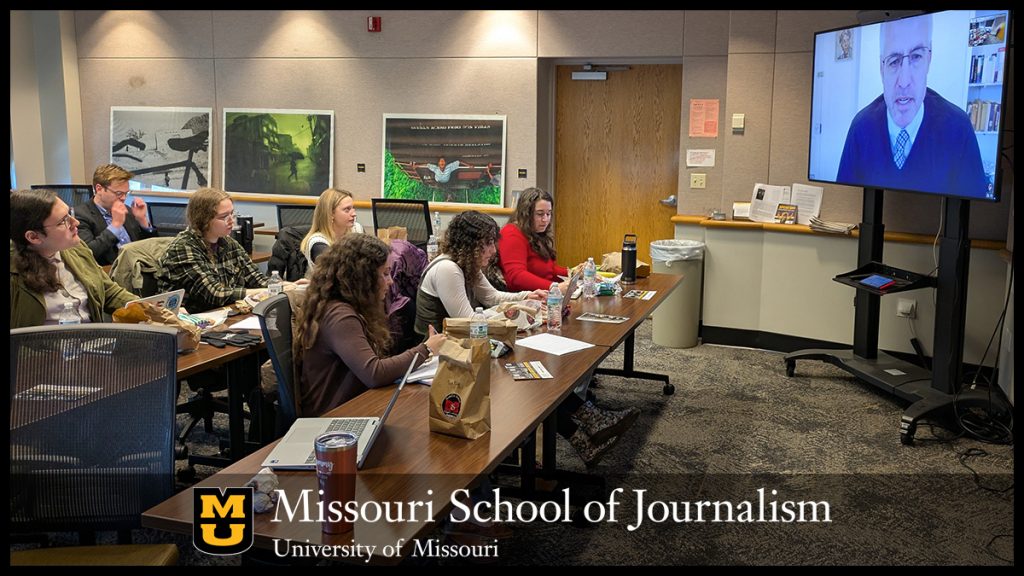
The ProPublica reporter discussed his long career in news and investigative reporting, how he builds narratives, finds sources, and draws connections between the different levels of society
Early in his career, newspaper reporter Alec MacGillis took a 33% pay cut and left his job at The Washington Post to tell hard-hitting narrative stories through magazine journalism at The New Republic. The risk paid off. His magazine stories have been featured in national outlets, including The New York Times Magazine and The New Yorker.
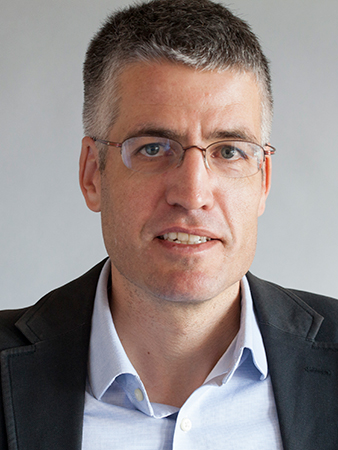
MacGillis is a fellow with the Watchdog Writers Group, a nonprofit fellowship program at the Missouri School of Journalism. The program has supported the reporting for his book on his hometown of Pittsfield, Mass. The book, forthcoming from W.W. Norton, follows Pittsfield’s prominent local newspaper, the Berkshire Eagle, and the arrival and departure of General Electric over the 20th century through the eyes of his father, Donald MacGillis, the executive editor of the hometown paper.
MacGillis gave a talk to students in December 2025 on narrative writing, sourcing, and interviewing, as part of the Watchdog Writers Group Lessons from the Field workshop series.
Take readers into hidden worlds
MacGillis started his presentation discussing his 2017 article in The New York Times Magazine on Jared Kushner’s real estate business in Baltimore. His article exposed the horrid living conditions of thousands of low-income tenants who were overcharged in rent, aggressively pursued for payments and fees and subject to hostile eviction behavior by landlords.
MacGillis said one of the most important parts of narrative storytelling is to take readers into “hidden worlds” to open their eyes to a reality different than their own.
Several scenes throughout the article paint a picture of the state of complexes with stains, broken appliances, and no hot water. MacGillis weaved in these descriptions with information on Kushner and the lawsuits to take readers into the hidden world of these vast apartment complexes.
“Readers love being taken into some universe or realm that they have very little experience with,” MacGillis said. “I came to think of this piece as a piece about Kushnerville. Any detail that recreates this universe helps people envision it. The holes in the wall, the mold, the terrible state that they’re in.”
Make connections between the top and bottom
MacGillis explained shining light on corruption in business or politics requires reporters to find ways to show decisions by the people at the top effect the people at the bottom.
“In this case, it was the most dramatic connection you could ever hope to have,” MacGillis said. “The son-in-law of the president literally had an office next to the Oval Office, sitting there in this seat of incredible power while his personal family real estate company is having this really dreadful effect on people in these completely forgotten places, complexes out on the edge of town, only 40 miles away.”
Spread information throughout the story
MacGillis also highlighted that while building a story, a writer should create curiosity by spreading information throughout a story as opposed to a news article with all of the important details at the beginning. This allows readers to absorb the information in a deeper way and let their own morals dictate how to interpret it.
“If you’re just going to throw it all up in the top, almost like a criminal indictment or a press release from a criminal indictment… what reason does anyone have to read further,” MacGillis said. “You’re trying to bring them into this whole world. You’re trying to build curiosity, build interest.”
“It’s a more powerful way to absorb the outrage than being told right off the bat,” he said.
Build up your subjects so readers care about them
Another crucial element of narrative reporting is to get the reader to care about the subjects of the story. MacGillis doesn’t just give an anecdotal lead about a person; he gives them shape by providing details about who they really are.
“To build that curiosity and interest in the part of the reader, you really have to get them to care about the people involved,” MacGillis said. “And that means as much as possible, developing at least some of your people as real rounded people, not just anecdotal leads, not just the token anecdotal lead, the token victim, and giving them some real shape.”
Use your own voice
When MacGillis brings a subject into a story, he limits the number of quotes he uses so he can write in his own voice. He only includes a quote when it adds a new element to their character. A reporter can do this in any type of reporting whether it be a long-form magazine story or coverage of a school board or local government. Building a voice as a writer is essential.
He added that he appreciates how magazine writing is less about being purely objective. He likes to tell stories from a certain perspective while still being accurate and honest in his reporting.
Another factor of reporting with your own voice is building authority and credibility as a journalist. By doing your own research and deeply understanding what you’re reporting and writing about, your voice becomes more powerful. MacGillis highlighted that a large part of his research is reading previous coverage on the same topic or person.
“In that reading, you are getting enough grasp of the subject that you can then write about it with a voice of authority.”
MacGillis then opened up the talk to questions. Jennilyn Wiley, the newly appointed head of the Journalism Library at the University of Missouri, asked MacGillis about his research process and methods.
“Read as many clips as time allows and figure out what’s already been said on the subject and take down all the names that you come across in those pieces,” MacGillis said. “Start calling those people.”
“Learn how to talk to people in a universe completely different than your own. It’s as much as possible about just right off the bat, trying to establish human connection with people. And get them to understand who you are, where you’re coming from.”
Alec MacGillis
MacGillis has five newspapers delivered to his door daily and 20 to 25 magazines each month. Keeping up with the news is how he finds inspiration for his own stories. After the 2016 election, MacGillis read profiles on Kushner which led him to investigate his real estate holdings.
“There were some profiles of Kushner shortly after the ‘16 election when Trump won, profiles of this you know, his young son-in-law who’s suddenly going to be very powerful…” MacGillis said. “They mentioned that he had a lot of, his company had a lot of apartments in Baltimore. And I was like, what? I live in Baltimore; I have no idea about this.”
Nico Berlin, a sophomore journalism major, asked how MacGillis developed strategies to approach people hesitant to be interviewed. MacGillis emphasized the importance of practice.
“Learn how to talk to people in a universe completely different than your own,” MacGillis said. “It’s as much as possible about just right off the bat, trying to establish human connection with people. And get them to understand who you are, where you’re coming from.”
MacGillis added that there are many ways to make a connection with a stranger, sometimes unexpectedly. While he was writing the Kushner story and trying to find sources, he saw a resident with a Bengals sticker on his car. MacGillis took that as an opening to talk to him, first mentioning their rough loss to break the ice and then bringing up that Kushner owns the apartment complex where he lived.
Berlin, the data and investigation chief for The Maneater, the University of Missouri’s student newspaper, said the workshop provided a new tool of narrative storytelling for their investigative work. She said she wants to highlight regular people in their stories to show what’s really happening and help readers care about a problem.
“In the past, I’ve seen a lot of reporting focus on those statements from spokespersons, and I would like to re-emphasize the importance of getting interviews from people in the community,” said Berlin. “He literally went down into Kushnerville and just started talking to people who he knew were living in those conditions.”
The Watchdog Writers Group hosts a fellow nearly every month to teach a workshop on investigative journalism. Lessons from the Field workshops are open to all Missouri School of Journalism students, staff and faculty. The next workshop, led by WWG fellow Ted Genoways, a James Beard Award winning food reporter and author of six books, will discuss how to ethically cover vulnerable food workers in the Trump era. The workshop, Thursday, Jan. 29, is from noon to 2 p.m. in Lee Hills Hall, room 303. It can also be accessed via Zoom. Click here to RSVP.
Visit the WWG website to see all upcoming events for the spring semester.
Updated: January 26, 2026