How news audiences really perceive bias
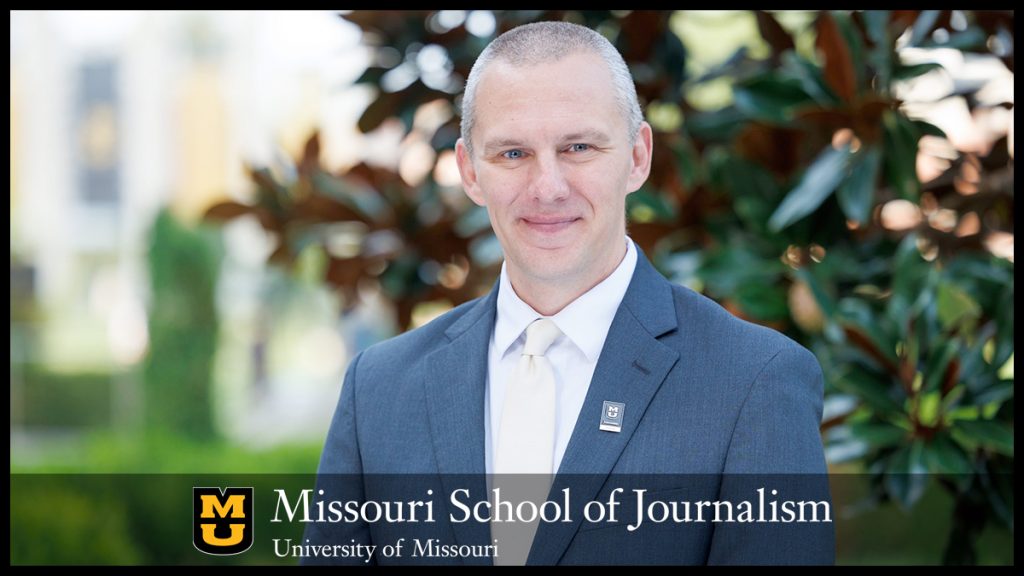
Nick Mathews finds that bridging the gap between news media and the public is not as simple as tiptoeing around political flashpoints
COLUMBIA, Mo. (March 3, 2026) — It’s an inescapable fact: public trust in news media remains at a historic low point, driven in large part by perceptions that news organizations produce excessively biased coverage.
But effectively repairing the relationship between news and its audiences is easier said than done in an era when inflammatory rhetoric and increasing aggression toward journalists often prevails over thoughtful discussion. That’s where research from Nick Mathews, an assistant professor at the Missouri School of Journalism, comes in.
In a new paper published in Journalism Studies, Mathews and colleagues at the University of Oregon and the University of the Philippines conducted in-depth interviews with audiences around the country. They found that a common assumption about criticisms of bias — that imbalances in coverage of hot-button issues such politics and the economy alienate or anger segments of the audience — misses a more fundamental truth.
“There is a perception that the media is universally biased,” Mathews said. “It’s not necessarily a matter of political ideology or anything along those lines. We’re all humans with our own biases, and so people feel like they need to have skepticism about what they’re reading.”
On one hand, this finding might seem a bit disheartening. It suggests producing more balanced and representative coverage is not a cure-all for the trust issue, an idea possibly supported by The Washington Post’s recent contractions after making moves ostensibly aimed at cultivating a broader audience.
“There is a perception that the media is universally biased. It’s not necessarily a matter of political ideology or anything along those lines. We’re all humans with our own biases, and so people feel like they need to have skepticism about what they’re reading.”
Nick Mathews
Mathews, however, sees a silver lining. While research into audience perceptions is typically conducted through surveys with closed-ended questions and sorts narratives about the news into rigid categories, Mathews and his team took an open, ground-level approach to interviewing his subjects. Rather than asking about bias, they allowed participants to bring up the topic on their own, allowing organic conversations about perceptions to take shape.
The result? Those perceptions (“folk theories,” in the parlance of the paper) are more nuanced and news literate than prior research has suggested.
“Audiences understand they need to be thinking critically about everything they read, and that’s a good thing — that’s different from thinking cynically,” he said. “It holds news and journalism accountable, and we need to be accountable for what we do.”
He added that part of what distanced participants’ views so firmly from cynicism was a surprising sentiment: empathy for journalists. Participants, though acknowledging that inherent biases exist in everyone, did not place blame for biased coverage on individual journalists. Instead, they thought of journalists as part of a larger entity or profit-driven system that can exert an unwelcome influence.
The takeaway for news organizations, then, is not about adjusting content but about embracing transparency, whether it’s in terms of finances, the editorial process or what happens when important sources refuse to comment. (The latter is currently the subject of a different research effort from the School’s Reynolds Journalism Institute.)
“Audiences understand they need to be thinking critically about everything they read, and that’s a good thing — that’s different from thinking cynically. It holds news and journalism accountable, and we need to be accountable for what we do.”
Nick Mathews
“Nick’s research is similar in some ways to great reporting; it goes straight to the source to get the unvarnished truth from the people community journalism is meant to serve,” said David Kurpius, dean of the School of Journalism. “This is the kind of perspective news organizations need to hear to build a sustainable future for the industry.”
In fact, Mathews already has a real-life example of how news organizations can act on that perspective. He points to Joey and Lindsey Young, the owners and publishers of three weekly newspapers in Kansas. (Mathews wrote about the Youngs in his book, “Reviving Rural News,” co-authored by Teri Finneman, MA ’10, PhD ’15, and Pat Ferrucci, PhD ’13.) When the time came for the Youngs to increase the price of one of their publications, Harvey County Now, they did so not with an impassioned defense of the mission of journalism but with a painstakingly detailed explanation of the newspaper’s finances.
This approach extended to telling readers exactly how much the Youngs were earning from the paper as a couple. Mathews argued such openness helped counter a persistent view among the public that owners of news media are raking in extreme profits. More broadly, though, it linked back to audiences’ desire for accountability.
“Joey [Young] and I have talked a lot about the fact that we need to be as transparent as the transparency we demand from others,” Mathews said. ”I think that goes a long way.”
The paper, “Folk theories of news bias: How audiences perceive, interpret and experience it,” was published in Journalism Studies on Feb. 11, 2026. In addition to Mathews, the paper was authored by Seth C. Lewis, who will join the faculty of the University of Virginia in August after serving as director of the journalism program at the University of Oregon, and Jon Benedik A. Bunquin of the University of the Philippines.
Updated: March 4, 2026