Missouri School of Journalism student wins Top Student Paper at AEJMC Southeast Colloquium for third year in a row
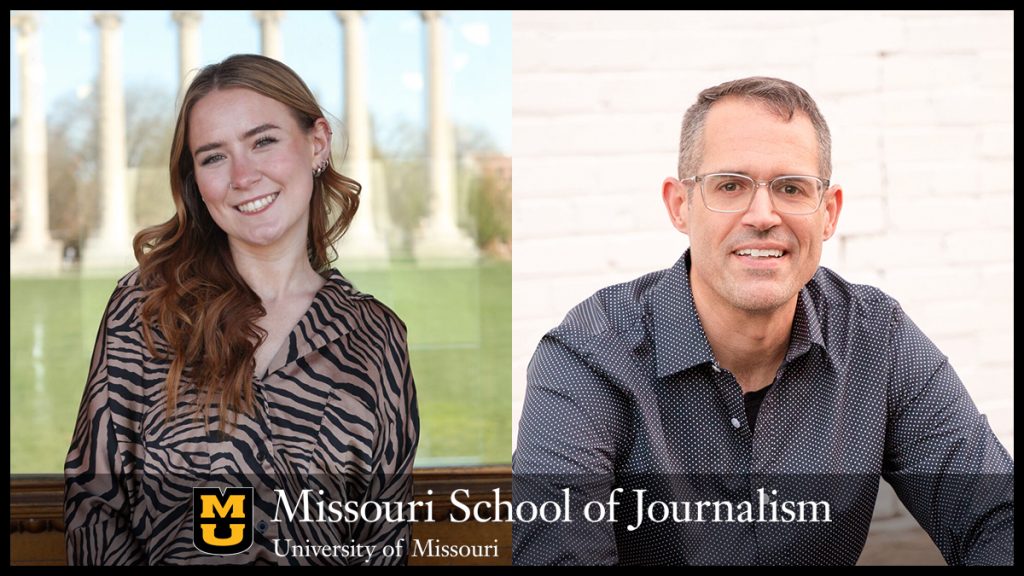
Anna Sago (left) and Jared Schroeder
Associate Professor Jared Schroeder also won the conference’s Top Faculty Paper award in the law and policy division
For the third straight year, a Missouri School of Journalism student has won the Top Student Paper award in the law and policy division at the AEJMC Southeast Colloquium conference.
The award-winning paper from Anna Sago, BJ ’25, who is pursuing her master’s degree as part of the School of Journalism’s Accelerated Master’s Program, is just one highlight from a roster of 12 journalism graduate students and 8 alumni presenting their research at this week’s prestigious regional conference — the oldest such conference within the Association for Education in Journalism and Mass Communication.
“Winning the Top Student Paper award three years in a row is no small feat, and it reflects the openness of our students at all levels to engaging in rigorous research that serves the industry,” said David Kurpius, dean of the School of Journalism. “Credit is also due to faculty who work hard to present students with a deep breadth of opportunity and hands-on experience.”
Sago’s paper, developed under the mentorship of Associate Professor Jared Schroeder (Sago is the sole author), was inspired by her internship with the Minnesota Star Tribune this past summer, when Minnesota House Speaker Melissa Hortman and her husband were assassinated by a lone gunman. Digging into the story, Sago was struck by a detail in the accused assassin’s notebook: a list of “people search” sites that offer searchable databases of personal information like phone numbers, emails and addresses tied to names.
“I was curious about why these are allowed to exist,” said Sago, who plans to move on to law school after earning her master’s degree. “Can they be regulated? What are they? It’s all a little bit opaque.”
“Winning the Top Student Paper award three years in a row is no small feat, and it reflects the openness of our students at all levels to engaging in rigorous research that serves the industry. Credit is also due to faculty who work hard to present students with a deep breadth of opportunity and hands-on experience.”
David Kurpius, dean, Missouri School of Journalism
Sago’s paper analyzed several bills that have attempted to increase privacy protections for lawmakers and other public servants, as well as a seemingly landmark decision by the U.S. Supreme Court to make it more difficult for prescriber data to be used for targeted drug marketing to state employees.
She found that policymakers have not attempted to piggyback off decisions like that one to push for greater protections of public servants, at least in part because such bills must navigate a complex legal minefield to avoid impacting existing protections for activities like journalism.
Sago sees a few potential solutions beyond legal reform, such as public servants using PO boxes to communicate with constituents and thinking more broadly about how to balance accountability and safety. But she said the lack of a public conversation on this issue is the first hurdle to overcome.
“Lawmakers need to be held accountable — as a journalist myself, I really believe in that,” she said. “But what does accountability look like? It surely can’t be these horrible acts of violence. And especially on the state or local level, many of these representatives are everyday people who might not get paid a lot and are just trying to serve their community. That angle just hasn’t been discussed as much.”
Schroeder said the paper’s win is a testament to Sago’s work ethic and willingness to tackle a complex, nuanced topic as a young student.
“Lawmakers need to be held accountable — as a journalist myself, I really believe in that. But what does accountability look like?”
Anna Sago
“She’s not some grizzled old graduate student — she’s right off her undergraduate degree,” he said. “A good paper like this requires a lot of critical thinking, which is a hard skill to teach, and that’s not just her professor talking. Three scholars from around the country looked at her work with no idea what university she was at or what level of student she was and said, ‘This is excellent work.’”
Schroeder doesn’t necessarily see a secret sauce in the consistent success of his students’ papers, though his seminar in communication law has produced each of the last three Top Student Paper wins. But he does point to his emphasis on structured preparation, which helps his students — most of whom have never put together a research paper before — go into the work with a confident plan of attack.
He calls this approach ‘scaffolding,’ and it serves to balance his hands-off approach to the content and authorship of his students’ papers. He doesn’t assign research topics; instead, he wants to ensure that student researchers create detailed, realistic proposals and outlines before diving in.
“A well-organized paper is going to be far more successful, and it’s easier to write,” he added. “So we spend a lot of time on the outline. I think that makes a huge difference in the process. It sounds boring, but the students know what they’re trying to accomplish.”
Other students and professional alumni of the School of Journalism will also present their research at the Colloquium, as well as Schroeder himself, whose paper analyzing how the Supreme Court makes decisions surrounding the First Amendment won the Top Faculty Paper award in the law and policy division.
The full list of attendees from the School of Journalism and their presentations or roles at the conference can be found below.
Students
Chris Duan
- “Why journalism cannot legitimize itself: Comparative insights from the United States and China.”
Tannor Enyart
- “Wanna bet? Examining editorialized commercial speech rights for the sports gambling industry.”
Misbahul Haque
- “Defamation by AI: Actual malice, artificial intelligence and the future of fault.”
Md Saddam Hossain
- “Law to protect or perish journalism: An approach of government-mandated self-regulation in journalism.”
Pranaav Jadhav
- “From community media to community anchors: How independent YouTube journalists in India negotiate legitimacy, autonomy and algorithmic precarity.”
- “Framing crisis in real time: Emotional, investigative and community narratives in 2025 U.S. aviation disaster coverage.”
Anuja KC
- “‘Invisible voices’ in the discourse of mental health: A critical discourse analysis.”
Roman Kolgushev
- “Generating Meaning: How should the Supreme Court conceptualize AI-generated propaganda?”
- “Conceptualizing trust in chatbots, powered by artificial intelligence.”
Saurav Rahman
- “Fair use or theft? The rising debate over AI scraping of news media.”
- Živilė Raškauskaitė and Hannah Artman (postdoctoral research fellow)
- “Local news on social media: Aggregating and politicizing community information.”
Anna Sago
- “Data brokers, privacy legislation and commercial speech 15 years post-IMS.” Top Student Paper.
Matthew J. Surmaczewicz
- “Free speech in the age of the digital soldier: How First Amendment rights and military service collide in the digital age.”
Laiba Khan Zai
- “News and scientific uncertainty: Reassessing the marketplace of ideas in the age of health misinformation.”
Faculty
Jared Schroeder
- “A Calvinball court: In search of First Amendment theory in recent emerging-technology Supreme Court cases.”
- “Common ground: Conceptions of truth and free expression in Holmes’ Abrams dissent and Stanton’s woman’s bible.”
Alumni
Ivy Ashe, MA ’10
- “Assessing the relationship between platform visuality, trust and news-finds-me perceptions for social media users.”
- Moderator, panelist.
Lisa Lenoir, Ph.D. ’22
- Panelist.
Joy Mayer, MA ’11
- Panelist.
Damilola Oduolowu, Ph.D. ’25
- “Complicating the narrative: Intersectionality as the counter-narrative to traditional objectivity in community environmental journalism.”
Gregory Perreault, Ph.D. ’15
- “Stormchasing and the performance of adrenaline-fueled disaster reporting.”
Mimi Perreault, Ph.D. ’16
- Moderator, panelist.
Daxton “Chip” Stewart, Ph.D. ’08
- Panelist.
Kim Walsh-Childers, BJ ’82
- Panelist.
Updated: March 12, 2026