Frank Corridori helps students design creative futures at Missouri School of Journalism
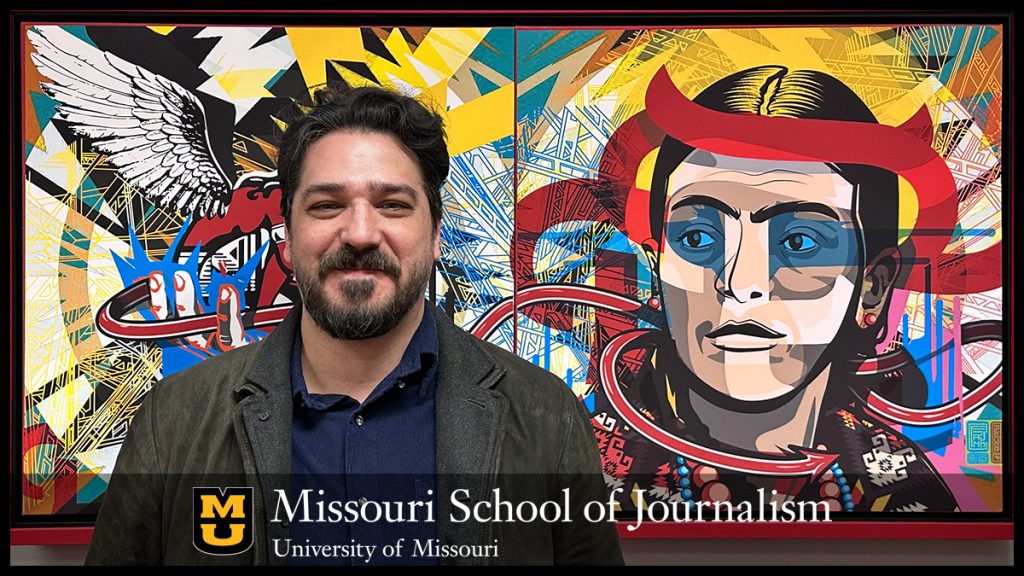
Frank Corridori stands in front of Muralistic Princess, which hangs outside his office in the strategic communication suite. The artwork is one of 15 prints hanging throughout the suite.
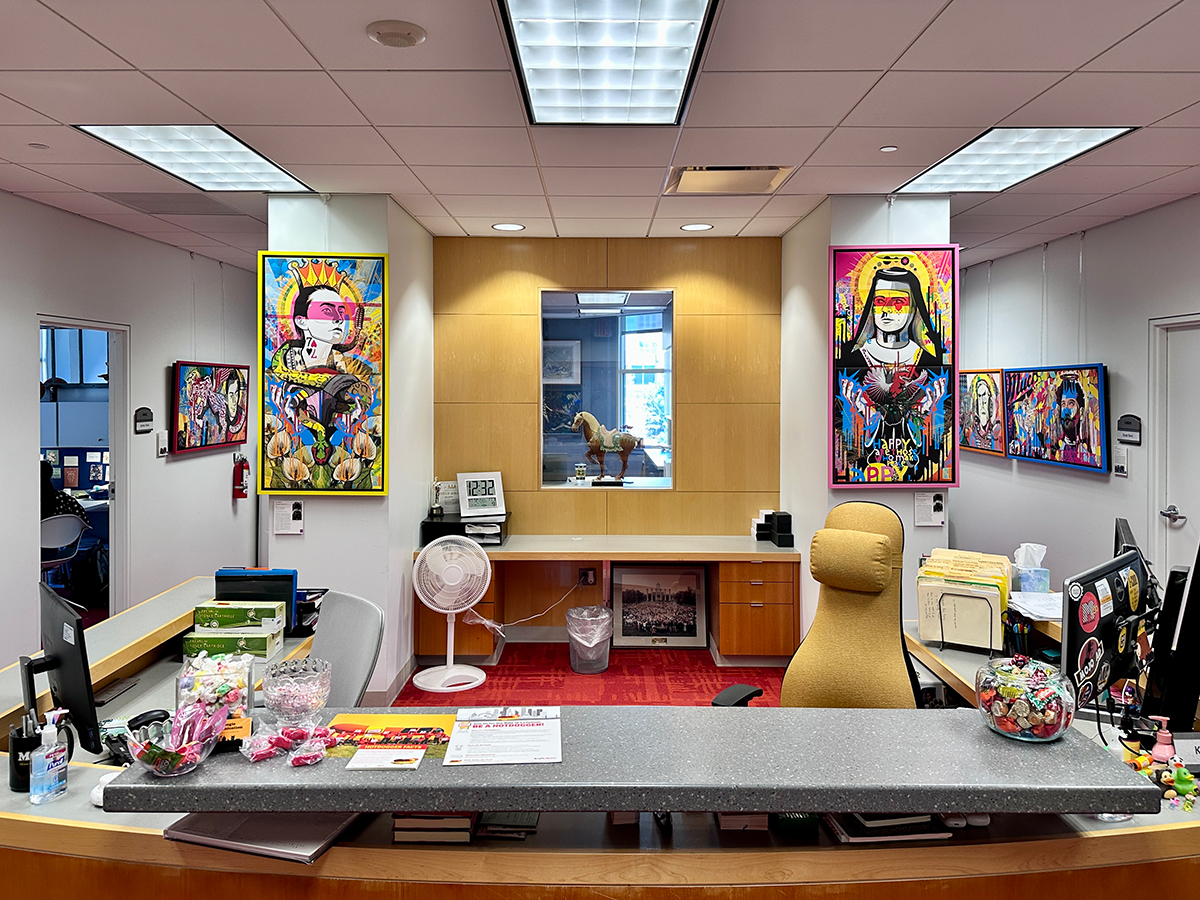
An exhibition of Professor Frank Corridori’s artwork currently adorns the walls of the strategic communication offices at the Missouri School of Journalism. In a series of prints titled “After Your Heroes,” he depicts important figures in the world of visual design that he hopes will inspire students to discover their own new role models in the fields they are passionate about.
As if to lead by example, the art that hangs behind him in his office is not his own work but an illustration by Ralph Steadman, who gained fame as a creative partner of counterculture journalist and writer Hunter S. Thompson.
It’s an illustration from “Fear and Loathing in Las Vegas,” and the chaotic, surreal ink strokes reflect a central tenet of Corridori’s teaching. As creative director of the School of Journalism’s student-staffed ad agency, MOJO Ad, and an instructor of strategic design and visual communication in advertising, he wants students to learn how to think differently.
“If you think about other disciplines, like STEM fields, you’re taught to arrive at a predetermined solution,” Corridori said. “But with creativity, there are often several really good options. There is no playbook — you have to make the playbook yourself. That’s really what I’m trying to teach my students; understand what’s being asked and apply your thinking in multiple ways.”
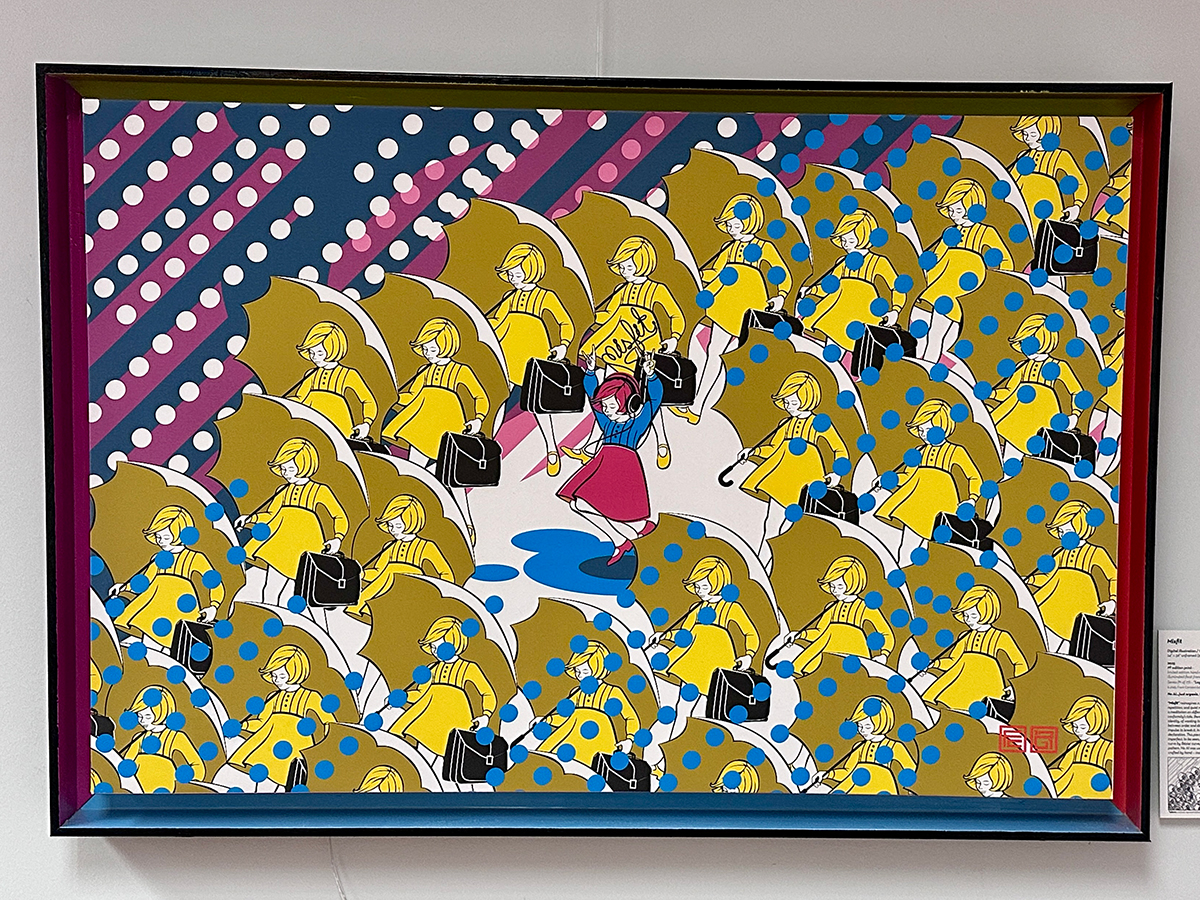
That approach to creativity — a concept known formally as “divergent thinking” — has inspired his award-winning advertising students to depict figures from classical art riding Vespa scooters, make designer fashion approachable by incorporating a children’s doll aesthetic and compose ice cream ads with a kaleidoscopic, retro-infused style.
It has inspired Corridori himself to continue to pursue art and design work outside of his educational roles, allowing him to bring the perspective of a working designer into the classroom. Then there is the work that now hangs in the School of Journalism’s strategic communication suite, which features a blend of digital illustration and fine art techniques. His eye for innovation even extends to the handmade frames, which can light up with the flip of a switch to draw out certain features in his compositions.
Beyond the figures depicted, the message the exhibition sends to students is clear: Corridori does not define himself as “just” a teacher but a designer, an illustrator, a photographer, a writer, a leader — and he believes students should practice the same openness.
“Curiosity is a really important motivator in education,” he said. “People have to be curious enough to be self-motivated so they can say, ‘Wow, I love that. Why do I love that? How can I express myself in a similar way?’”
From San Fran to Santa Fe
Corridori has had scores of students win awards from organizations like the American Advertising Federation and the National Student Advertising Competition. Former students have gone on to land roles at high profile agencies; Nyah Evans, BJ ’25, for example, is an associate art director for the Wendy’s account at VML. Jack Rintoul, BJ ’23, is a creative at social-first agency NewGen in New York City. Others have worked at big industry names like 72andSunny and Droga5 in major markets.
And each semester at MOJO Ad, students develop campaign strategies for real clients and receive consistently favorable feedback from those clients, including NASA and Bath & Body Works.
“The success of Frank’s former students speaks to the value of the hands-on experiences in his classes and in MOJO Ad,” said David Kurpius, dean of the School of Journalism. “Having already put together real campaigns for real clients, they hit the ground running faster than many of their peers in the industry with the confidence and creativity Frank helped them nurture.”
But Corridori is equally proud of students who have found different routes to success with the foundation of curiosity and confidence he helped them build. GL Richardson, BJ ’16, is one such case.
Richardson landed a job at the acclaimed Goodby Silverstein & Partners agency after graduating from the School of Journalism, but he soon found that agency work wasn’t stoking his passion. Searching for a different artistic outlet, he was surprised to find himself drawn to painting cowboys.
“I had to pause and ask myself, why the hell are you painting cowboys?” Richardson said. “That’s not very authentic of you — you can’t even ride a horse.”
Realizing he had reached a decision point, he took a leap, moving from San Francisco to New Mexico to become a ranch hand. Not long after, he took a call from Corridori, and though it had been a few years since their last chat, the conversation turned in the same direction it always did — toward making fine art.
The call rekindled the relationship between mentor and mentee and gave Richardson another source of support as he worked to determine what his future held. And when he eventually decided to take the plunge and become a fine art painter of cowboys and western scenes, he not only found resounding success (his work will be displayed in April at LewAllen Galleries in Santa Fe, one of the premier galleries in the country) but found that Corridori’s instruction had prepared him in unexpected ways.
“A vast portion of what art requires is the way you present yourself, the way you talk about yourself, the consistency of treating it like a job and getting in the studio to grind,” Richardson said. “I could write about my work, talk about my work and understand the importance of story. People have to understand you and fall in love with what you’re trying to do, and those skills were a big takeaway from Frank.”
He recalls a specific project from his time at MOJO Ad, for which he wanted to create an ambitious shot with a green screen to make it look like someone was levitating off their bed. With Corridori’s input, he made it happen.
“He was always encouraging us to go the extra mile and try something a little different,” he added. “That has always stuck with me. It’s so instrumental at an early age to have someone pushing you to experiment and go further, to have someone who believes in you and sees promise in you.”
Corridori, on the other hand, maintained that the most profound impacts of the relationship have worked in the other direction.
“GL is the one who encouraged me to dive back into my fine art-oriented endeavors through his curiosity and courage,” he said, adding that he often thinks of his students as peers given how much he learns from them. “I greatly admire him, his mindset and his work.”
The importance of authenticity
Corridori’s own early inspirations came from his parents. His mother, who worked as an advertising art director before becoming a high school art teacher, made sure her son was always surrounded with the tools of the trade and given the opportunity to flex his creative muscles. His father, a software engineer — and, later, a university professor after retiring from IBM — lent a different but vital influence: an appreciation for the opportunities created when technology and creativity intersect.
“He worked at IBM, so he would bring home PCs,” Corridori said. “I was on the internet at a very early age, and when I was in elementary school, he even brought home a BASIC program and taught me how to code a little. The coding thing never really went anywhere, but I was more curious how that tech could be applied to art specifically.”
The trail of curiosity led him to web design, then to graphic design more broadly. Now, amid the explosion of generative AI, he retains much the same brand of scrupulous inquisitiveness. He introduces students to AI strategies that utilize the technology not as a crutch but as a gateway to fulfilling and enriching their creative impulses.
His students are not required to use AI in their projects; it’s presented as yet another tool in the toolbox of a visual designer, much like Photoshop or Illustrator in Adobe Creative Suite, both of which faced their own share of skepticism when they took the industry by storm. Perhaps more importantly, AI is a conversation starter that reveals some of the students’ deeply held passions and guiding philosophies, a process that ultimately serves to help them create more authentic and effective projects.
“He painted a picture with his words that very elegantly explained how cars aren’t just a way to get from Point A to Point B but are an extension of an individual. He wanted the students and faculty alike to see the car as a work of art.“
Jon Stemmle
“You see student teams that openly embrace AI and others that openly reject it,” he said. “Some students can be really resourceful in creating something without AI when others are using it. There are parts of both of those approaches that really resonate with me.”
Still, as Corridori acknowledges, technology never stops evolving. What continues to resonate with him regardless of the trends of the day is sincerity. Encouraging students to build campaigns with the same earnestness they would apply to their own private passion projects, he has a reputation for using his own near-inexhaustible creative energy to light a fire under future strategic communicators.
Professor Jon Stemmle, co-director of MOJO Ad, has seen that scenario play out time and time again.
“In 2019, the MOJO Ad client was Chevrolet, and to say Frank is a car enthusiast is a huge understatement,” Stemmle said. “As we were in class discussing the research about the car industry, he painted a picture with his words that very elegantly explained how cars aren’t just a way to get from Point A to Point B but are an extension of an individual. He wanted the students and faculty alike to see the car as a work of art, admiring the colors, shapes, curves and lines that take what could be a box on wheels and turn it into something sublime.”
In Richardson’s view, something similar could be said of Corridori’s role at Mizzou. What could be an ordinary strategic design course with an ordinary teacher is instead a challenge to push oneself further. And what could be a closed-off segment of the strategic communication department that locks students into specific paths is instead a place where ideas, goals and inspirations flow freely.
“Frank deserves a lot of credit for what Mizzou’s strategic communication program is,” Richardson said. “The cross pollination of core tenets like self branding — that’s a very different idea than what some people think when I say I went to Mizzou for the Journalism School. If you’ve got the chance to be in one of his classes, it’s worthwhile.”
Updated: February 19, 2026