Meet the 2026 Missouri Honor Medalists
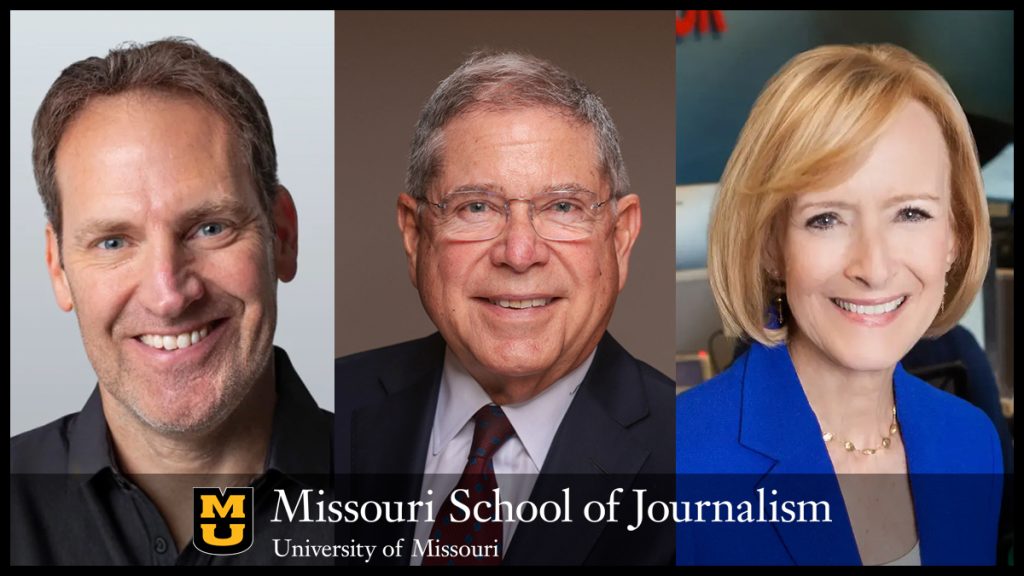
Three major figures in journalism and strategic communication will receive the 2026 Missouri Honor Medal for Distinguished Service in recognition of their extraordinary careers.
This year’s medalists are: Jon Cook, Global CEO of VML and WPP Creative, a multinational network of advertising agencies; Alberto Ibargüen, longtime news executive and former president and CEO of the Knight Foundation; and Judy Woodruff, a veteran broadcast journalist and a fixture in various roles at PBS NewsHour for 30 years.
The honorees will accept their medals during an evening ceremony on Wednesday, Sept. 23, at the State Historical Society of Missouri. Earlier in the day, they will speak directly to students and the public when they deliver free master classes based on their professional experiences.
“What connects Jon, Alberto, and Judy is their ability to look at a changing media landscape — whether the rise of the internet, the emergence of AI tools or shifting social divides — and see an opportunity to better serve their audiences,” said David Kurpius, dean of the School of Journalism. “They have pushed their respective fields forward without compromising on their core principles of integrity and service, and it’s an honor to present them with Missouri Honor Medals.”
Past winners of the prestigious honor represent a broad range of distinguished figures in the industry, including Christiane Amanpour, Sir Winston Churchill, Walter Cronkite, Maria Hinojosa and Gloria Steinem. Last year’s honorees were acclaimed journalists Jorge Ramos and Maria Ressa alongside influential PR executive John Saunders.
Meet the medalists
Jon Cook
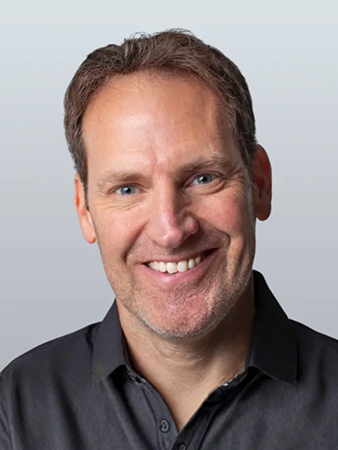
As Global CEO, Jon Cook, BJ ’93, has spent 30 years building the world’s largest advertising agency and serving the world’s largest brands. Additionally, Jon oversees a suite of global advertising, design and public relations agencies within the WPP portfolio, which includes VML, Burson, Ogilvy and AKQA. His success represents the culmination of a career spent at VML developing and applying his consistent approach to leadership.
“So many people chase the new technology, whether it be TV back in the day, the internet, mobile, AI,” Cook said. “And the secret to VML’s ongoing relevance is to never, never change the fundamentals of what we’re doing with the technology. It’s always been about serving the human being.”
That has not meant shying away from AI as a force for innovation. On the contrary, Cook sees new technology as additive to the fundamental goals and values of strategic communication.
“I’ve always been chasing the new way to communicate with an audience and build a company where you’re the master of the technology — the technology is not the master of you,” he said. “When you understand that, the technology of the day becomes an absolute weapon.”
He has applied a similar principal of self-determination to his career more generally, choosing to forge his own opportunities for leadership and success at VML and WPP rather than going the increasingly common route of leapfrogging from agency to agency. After becoming Global CEO of VML in 2011 (a title he retains alongside his WPP role), he worked to grow the agency from 30 employees to more than 25,000 across 150 offices and 64 markets while serving high-powered brands like Coca-Cola, Wendy’s and Ford.
As VML rose, so too did Cook. A Kansas City native and Missouri School of Journalism alum who started at VML as an account manager, he now oversees the agencies that constitute the world’s largest advertising and PR companies. The synchronicity between his career and the fortunes of the agency he has served for three decades is no accident. His aspirations and those of his colleagues have guided the agency’s growth.
“VML started in Kansas City, and as we grew, people potentially wanted to leave for companies that were more national,” he said. “So, we opened an office in New York, in Seattle, Detroit — London and Sydney and beyond. Over the years, we made VML the global ad agency that we would have wanted to leave for. Instead of people leaving for a more digital company, an AI company, a mobile specialist or a social media specialist, we built all of that into VML.”
Cook delivered the commencement address at the School of Journalism in 2018, 25 years after earning his bachelor’s degree in journalism.
Alberto Ibargüen
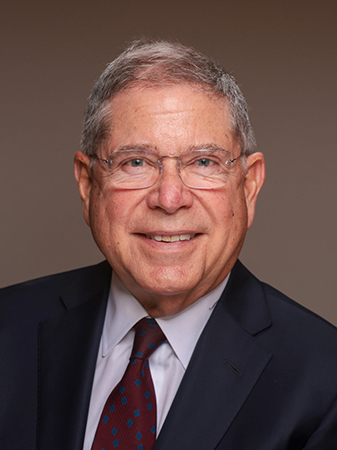
Alberto Ibargüen is a leader in news media and philanthropy, widely recognized for his visionary efforts to guide journalism into the digital age. As the former publisher of the Miami Herald and El Nuevo Herald, and the longtime president and CEO of the John S. and James L. Knight Foundation before his retirement at the beginning of 2024, Ibargüen has dedicated his career to community engagement and journalistic innovation.
If there is a conventional path to news leadership, Ibargüen’s path was anything but. He was the editor of his college newspaper, but after serving for five years in the Peace Corps in South America — including time in the Amazon and as a program director in Colombia — he earned a law degree and began his career at the Legal Aid Society in Hartford, Connecticut, where he focused on assisting underrepresented communities. He later transitioned into private practice before rediscovering a passion for the news industry when he joined the board of the Hartford Courant, Connecticut’s largest daily newspaper.
After a tenure as executive vice president of Newsday and New York Newsday, Ibargüen moved to Florida in 1995 to lead the Miami Herald and El Nuevo Herald, where he became an early champion of digital platforms. He eventually brought this forward-looking philosophy to the Knight Foundation, shifting its funding strategy toward digital experimentation. Under his leadership, the foundation invested hundreds of millions of dollars into experimental media projects, with the most successful endeavors receiving ongoing support.
“Our best grants were always when we would find a really bright person who had the capacity or the team to implement the idea and to change when necessary,” Ibargüen said, noting that he recognized early the importance of adapting news to the internet rather than simply copying newspapers in a digital format. “The goal was to figure out not how to put the newspaper on the web, but how to be a natural informer of news and information and be natural to the medium so that we’re actually engaging the audience where they are.”
He has also made a point of wearing influences from the arts on his sleeve. One key moment in his leadership development came during an electronic music concert he attended from avant-garde musician John Cage at Wesleyan University.
“He had put metal sheets sort of thrusting out toward the audience from the stage, and then he rolled ball bearings on them that went, ‘plink, plink, plink,’” Ibargüen said. “And I thought, ‘If this is music, then there are no rules except for the blinders you’re willing to put on your own imagination.’ But there was nevertheless a score that went from point A to point B and achieved a goal. And that’s a great way to think about living and a great way, ultimately, to run a foundation. That evening was an amazing moment in my life.”
A longtime board member of the Committee to Protect Journalists and other non-profit organizations, he received a Maria Moors Cabot citation from Columbia University in 2003 for his work with the Inter American Press Association to protect Latin American journalists.
Judy Woodruff
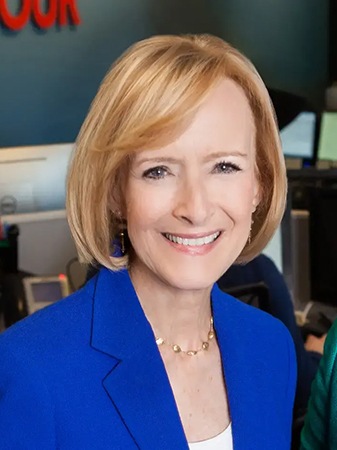
Judy Woodruff’s acclaimed career in broadcast journalism has spanned more than five decades in local, network, cable and public television news. She has covered every presidential election and convention since 1976, interviewed numerous world leaders and moderated presidential debates.
After serving for many years as the anchor and managing editor of “PBS NewsHour,” she stepped down at the end of 2022 to spearhead “America at a Crossroads,” a multi-year reporting project for PBS dedicated to exploring the nation’s political and social divides.
Her first television job was as a newsroom secretary in Atlanta in 1969, where she pushed for on-air opportunities at a time when broadcast journalism was a male-dominated field.
“At that point, they had one woman reporter at each station in Atlanta,” she told The Story Exchange in 2023. “I started pestering the news director to let me go out with a reporter and a camera crew, just to observe. His answer was, ‘Well, why would you want to do that, Judy? We already have a woman reporter.’ This was 1969.”
Her persistence paid off when a reporting slot opened up the following year, launching a career that would take her to NBC News as a White House correspondent, to CNN as host of “Inside Politics” and “CNN WorldView,” and to PBS — where she and Gwen Ifill became the first two women to co-anchor a national news broadcast. She has also anchored several PBS documentary series, including “Frontline with Judy Woodruff,” which ran from 1984 to 1990.
Seeking to pave a smoother road for future generations of women in journalism, she co-founded the International Women’s Media Foundation in 1989 to support and empower women in the industry.
Throughout her decades on the air, Woodruff has distinguished herself with a commitment to rigorous fact-finding, fairness and transparency. And even after transitioning away from the daily demands of the anchor chair, Woodruff remains focused on serving the American public through deep reporting as a senior correspondent for PBS NewsHour.
“Those of us who care about informing the public don’t have the option of stepping away,” she said in a 2012 lecture at the University of Southern California in Los Angeles. “We bring an enthusiasm and determination to get the story right and to serve the American people that I can promise you is not going away.”
Updated: July 15, 2026