Jared Schroeder named Lee Hills Chair in Free-Press Studies at Missouri School of Journalism
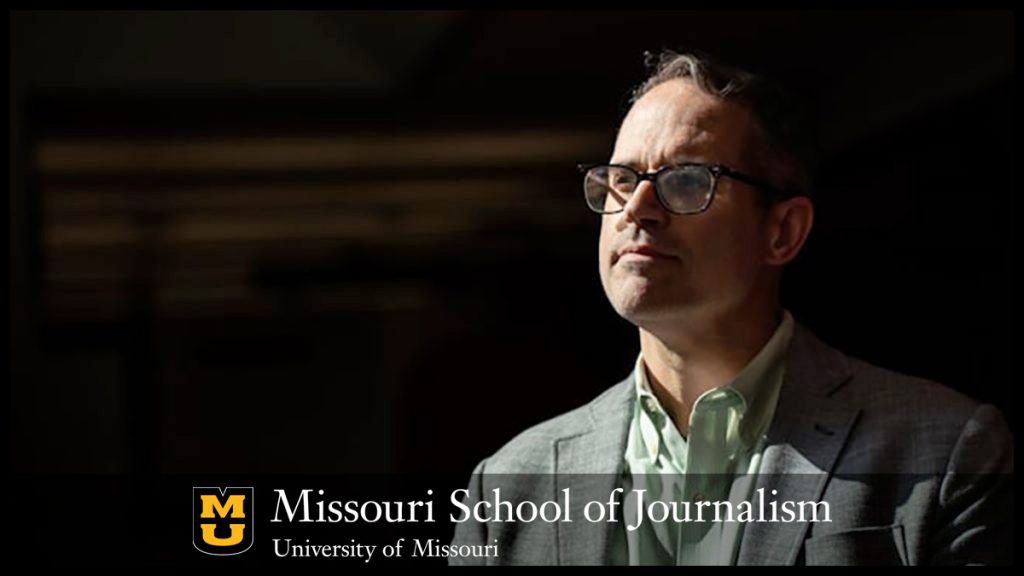
COLUMBIA, Mo. (July 21, 2026) — The Missouri School of Journalism has named Professor Jared Schroeder the Lee Hills Chair in Free-Press Studies. An expert in First Amendment law and its applications in the age of AI, Schroeder steps into a major role supporting preservation and public awareness of a free press nationally and around the world.
Schroeder’s selection comes after a national search, with his knowledge as an educator, researcher, author and industry commentator in the realm of media law making him a strong fit for the chair — part of a national network of Knight Chairs in Journalism supported by the John S. and James L. Knight Foundation.
The chair is named for Lee Hills, who had a long and varied newspaper career. He worked as a reporter, foreign correspondent, news editor, editorial writer, editor, managing editor, executive editor, and publisher and CEO of two major newspapers, the Detroit Free Press and the Miami Herald. Hills, who attended the Missouri School of Journalism between 1927 and 1929, was also the first chairman and CEO of Knight-Ridder Newspapers.
“Jared’s profound understanding of First Amendment law and his forward-looking vision will ensure that the School continues to be a vital hub for championing and protecting a free, independent press,” said David Kurpius, dean of the School of Journalism.
Schroeder takes on the role three years after joining the School of Journalism, where he arrived after eight years as a prolific researcher and teacher at Southern Methodist University. In his time at the School, he has continued to conduct timely research while mentoring graduate and undergraduate researchers producing distinguished work of their own.
“We need a free press because they’re the people in our society who are out there holding our public officials accountable, the people who have a stated professional interest in conveying accurate information to us.”
Jared Schroeder
Two major resources for the industry have arisen from those efforts: a legislative tracker tracing state government efforts all over the country to support local journalism, and a state-by-state database of anti-SLAPP statutes and related information to help news organizations navigate malicious defamation lawsuits. The former was recently updated to include 2026 legislation, and Schroeder is currently working on an update to the anti-SLAPP database.
At the same time, Schroeder has become a prominent industry voice clarifying the path forward for the industry at a time of rapidly evolving technology and a national conversation around the role of a free press. He has authored three books (with a fourth due to be published in January) and penned incisive articles for publications like Nieman Reports. Along with hosting a podcast for educators on AI literacy, his work has typified the mixture of public service and academic rigor that defines the Lee Hills Chair.
Now, he aims to leverage that thought leadership, as well as his ties to the School’s graduate and undergraduate research programs, to become a nexus point for collaboration with people engaging with free press issues from every angle.
“There are a lot of organizations that really care about a free press and are doing good work on their own — what if we get together?” Schroeder said. “The Lee Hills Chair should be a hub for journalists who have a free press problem, students who have a free press question, lawyers, lawmakers. We can bring those people together to help solve problems.”
But he won’t just be bringing people together; he’ll also be tying together the threads of his own career that has seen him approach free speech and free press studies from a variety of angles and contexts. According to Damon Kiesow, Knight Chair in Journalism Innovation at the School of Journalism, Schroeder’s multifaceted expertise is vital in an era of complex technological, economic and social challenges in journalism.
“Jared is a fantastic scholar and deep thinker on issues around the free press, ethics, the intersection of technology and journalism — all things in this day and age that are really important to the operation and sustainability of journalism,” Kiesow said. “He has the opportunity now to weave in all those skills and experiences into looking at what it means to be a modern defender of the free press.”
Schroeder also sees an opportunity to address a range of threats to journalistic freedom in addition to the more well-known acts of oppressive governments that tend to dominate headlines.
“We can’t just focus on government threats, even though those are very much there,” Schroeder said. “To our left, to our right, behind us, there are other threats we can’t ignore. Corporations have become powerful tools for limiting the ability of journalists to communicate. Technologies are undermining press rights. Economics are doing the same.”
At the root of it all is Schroeder’s mission as an educator. He said he hopes the funding and profile of the Lee Hills Chair will help him reach more people, whether they are students, teachers, peers in the industry or members of the public.
And while his collaborative projects as a professor at the School of Journalism have already made an impact, he intends to build more resources that not only help news organizations remain independent but demonstrate the value of a free press on a larger scale.
“We need a free press because they’re the people in our society who are out there holding our public officials accountable, the people who have a stated professional interest in conveying accurate information to us,” Schroeder said. “What I want to do is create curriculums, tools, talks and podcasts that will help people understand why we need those rights.”
Updated: July 21, 2026