Sports journalism course from SportsCenter alum John Anderson helps students broaden horizons, form industry connections
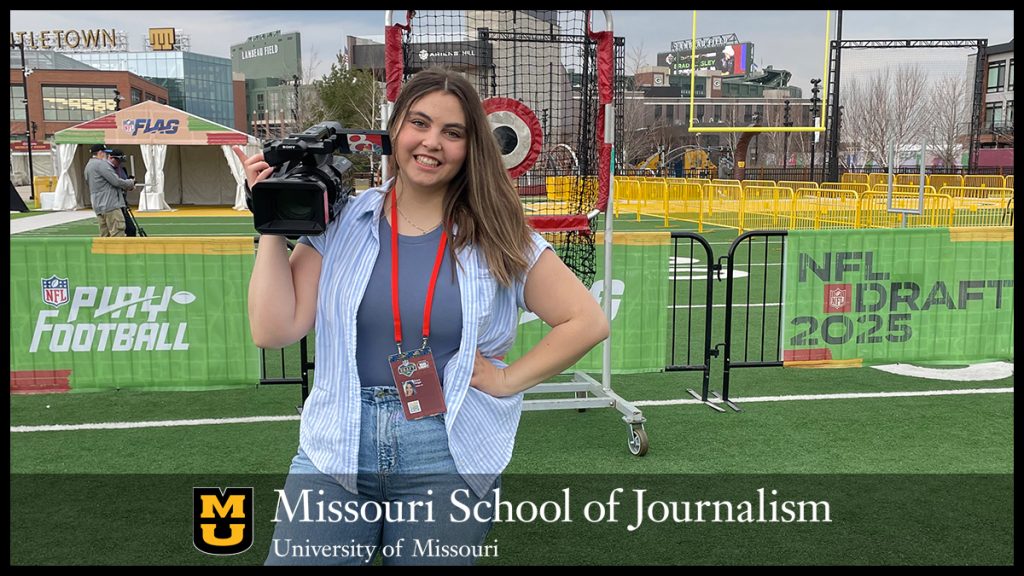
Grace Ainger at the 2025 NFL Draft in Green Bay, Wisconsin. She was one of six students Anderson brought to his hometown last April to cover the event.
The Missouri Method of learning by doing meets decades of ESPN experience
COLUMBIA, Mo. (April 16, 2026) — Passion for sports motivates students to pursue fulfilling careers in sports journalism and related industries. Amid a multitude of emerging roles and careers in digital media, blogging, podcasting and strategic communications, the Missouri School of Journalism now offers a new course in sports journalism to expand students’ minds and career opportunities.
Taught by John Anderson, BJ ’87, formerly a SportsCenter anchor for 25 years, the course lifts the curtain on what it’s like to work in sports while presenting a series of real-world learning opportunities.
Given Anderson’s extensive experience providing coverage of — and commentary on — professional and collegiate athletics, he is highly attuned to the aspects of sports journalism that make it unique.
“You have to understand the two biggest parts of it, which are the fan and the athlete,” said Anderson, the Leonard H. Goldenson Endowed Chair in Radio and Television Journalism at the Missouri School of Journalism. “We are the conduit between the two. So there is space to explore things like making sure we understand the pressure players are under and what they make, but also what it costs the fans. Okay, the Chiefs got a new stadium deal — we should be digging into things like that.”
![Aaron Segal [right] hosts Mizzou Volleyball's game day show with guest Colleen Finney before the team's match against Kentucky.](https://journalism.missouri.edu/wp-content/uploads/2026/04/sportspilot26041603.jpg)
Currently open to juniors and seniors, the course also presents an opportunity for students to engage with issues around public trust in journalism, given that sports reporting often covers highly emotional subject matter and can range from fact-based news to opinion and personality-driven content.
“Like the great Mizzou graduate Jim Lehrer said, there is room in any newscast for news, analysis and opinion,” Anderson said. “You just have to label them. If I’m the audience watching First Take as opposed to SportsCenter, I think the expectations are different. There’s room for both. But I do think it’s good to open it up for discussion and ask: At what point are people getting by on the strength of personality as opposed to strength of information, credibility and trust?”
In its first semester, the course had no trouble filling up quickly with driven students like Aaron Segal, a junior who already works for UFC covering fights during the summer in his hometown of Las Vegas. At Mizzou, he has covered women’s basketball for the Columbia Missourian — the Missouri School of Journalism’s community newspaper — and softball for Power Mizzou. In the podcast realm, he co-hosts Play Her Story alongside former Mizzou Volleyball star and current Miss Boone County, Colleen Finney, where they highlight the stories of female athletes.
Despite the experience Segal has already gained producing sports coverage, he said Anderson’s course has greatly expanded his understanding of the work he plans to pursue as a career after graduation.
“I’ve known sports journalism as play-by-play broadcasting, anchoring or writing,” Segal said. “John really makes sure that yes, we’re going to talk about those three, but we’re also going to talk about everything else that encompasses sports journalism. Each week is something new. Just this past week was budgeting and finances, and I learned about how the NIL Collective works. So it was really cool to say, okay, this five-star quarterback is worth $1.2 million. How is that going to work while building a defense or making sure he has an offensive line where he doesn’t get hit?”
![Grace Ainger [right] with J.D. Pruess, a former co-executive producer of American Ninja Warrior who began his career as a sports reporter and producer, during his visit to campus in November. Photo: Nate Brown](https://journalism.missouri.edu/wp-content/uploads/2026/04/sportspilot26041606.jpg)
And alongside the educational opportunities come the connections that sprout from Anderson’s network of professional colleagues.
“Gary Striewski is one of my favorite SportsCenter anchors, and John was able to help me connect with him,” Segal added. “John also knows I love women’s basketball, and he’s able to connect me with people through that. He cares about each one of the students and what we want to do.”
Fellow junior Grace Ainger’s favorite guest speaker so far has been ESPN sportscaster Scott Van Pelt, but her real professional connection came in the form of an internship with ESPN, where she will serve as a production assistant this summer on shows like SportsCenter and Get Up. She credited Anderson with giving her a leg up in securing the internship, which aligns with her interest in the broadcast production side of sports journalism.
Ainger — a producer at the School’s NBC-affiliate TV station, KOMU-TV, with experience in sports anchoring, reporting and producing sports programs like Mizzou Xtra and Friday Night Fever — added that the discussion-based format of the course reflects an openness to touching on a wide variety of subject matter.
“We dive into the different ways that an athlete can exist in society aside from throwing or catching a ball,” she said. “We spent a few classes talking about their experiences, even their mental health and all the ways they can approach athletics. It makes you more of a critical thinker, because there is so much more that is important to the fans, the coaches and the players than just the stats on the page.”
More than the score
For all the ways that sports reporting can be a singular experience for both journalists and their audiences, Anderson emphasized that the skills that make for good journalism apply as much to sports as to coverage of a city council meeting, a community arts event or any other news item.
The capacity for adaptability underlies the Missouri School of Journalism’s Missouri Method of real-world learning by doing, in which students cross-train in a range of professional newsrooms and mediums. And for Anderson, that adaptability is the difference between simply reading the scores and telling a story.
“The final score is just not always the storyline,” he said. “Stuff happens and you’d better be ready. What do you do when someone gets clocked under the basket and they take them off on a stretcher? I want to make sure students know that a lot of times, sports turns into news.”
But there was a glint in his eye when he noted that while the fundamental skills for reporters remain the same across all types of community reporting, sports holds an allure and significance for audiences that is unmatched. It’s a refrain his students have heard more than once.
“Sometimes, people say, ‘It’s just sports — whatever,’” Anderson said. “I’ve been to Faurot Field, I’ve been to city council meetings and I’ve been to school board meetings. Only one of them has 60,000 people show up.”
Updated: April 24, 2026