Sungkyoung Lee Honored with University of Missouri Chancellor’s Award for Outstanding Research and Creative Activity
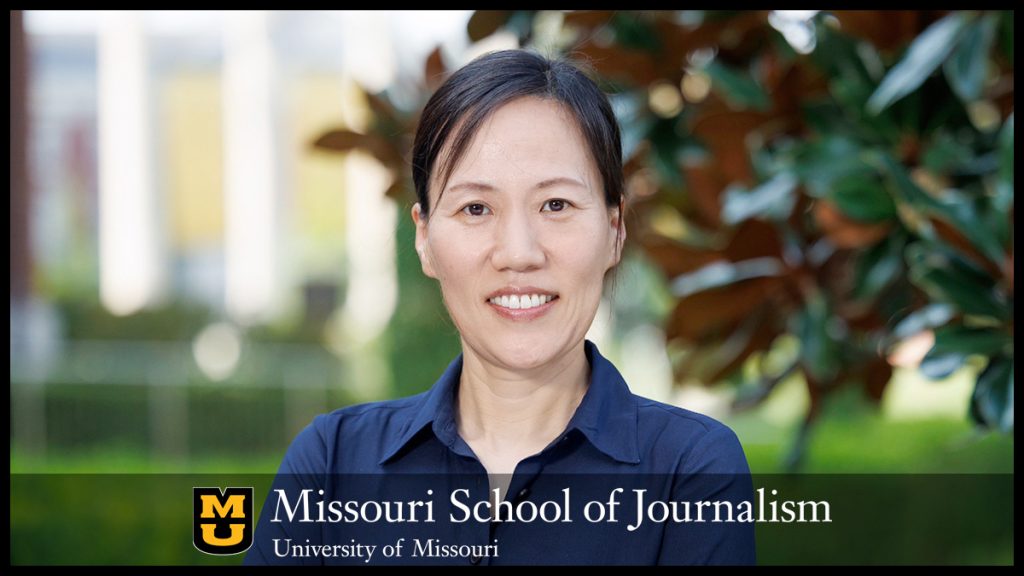
COLUMBIA, Mo. (May 13, 2026) — Sungkyoung Lee, an associate professor at the Missouri School of Journalism, has received the Chancellor’s Award for Outstanding Research and Creative Activity.
The campus-wide award celebrates mid-career faculty who have made significant contributions to their fields through rigorous inquiry. In Lee’s case, the award honors the steady evolution of a research approach that bridges the gap between the mechanics of the human mind and the study of media messaging.
“Sungkyoung Lee has earned a strong reputation nationally, internationally and within the University of Missouri community as a recognized leader in the field of biometric behavior and across a myriad of other related fields,” said David Kurpius, dean of the School of Journalism. “It’s great to see her honored with this award.”
Since joining the School of Journalism in 2014, Lee has concentrated her research on the psychological effects of media. Instead of focusing on what audiences consume, she looks at how their brains process media messages in real time.
And when it comes to creativity, her research has evolved from what she described as “theory testing” to a more topical approach that takes into account the most pressing concerns and interests of health communicators. This has opened her up to new subject matter, like the impacts of AI on media consumption, and has also opened the door to more collaboration with colleagues at Mizzou and beyond.
“Now I can accommodate more topics, which sometimes requires thinking differently,” Lee said. “It’s a more mature approach where I’m not refusing to follow the most recent phenomena just because it’s new and doesn’t fit into what I did before. It’s more applicable in the real world.”
At the same time, the self-described maturation of her approach has only added to her stature in the industry. Shuhua Zhou, a professor emeritus at the School of Journalism who served as Lee’s tenure committee chair, noted Lee’s impressive productivity in his letter nominating Lee for the award.
“Dr. Lee exemplifies the very qualities this award seeks to honor: a mid-career scholar of exceptional productivity, influence and promise whose research contributions are both impressive and demonstrably accelerating,” Zhou wrote. “Remarkably, in 2024 alone, she published six papers — a rare and extraordinary rate of productivity in communication and the social sciences.”
The science of attention
A hallmark of Lee’s career has been her pioneering work in psychophysiology, which non-invasively measures the body’s physical responses (both involuntary, like heart rate, and voluntary actions like pressing a button) to determine how mental activity affects those responses. She was among the first to bridge the science of information processing with health communication in this way, an important step forward for health communication research that had previously relied more or less exclusively on self-reported data or observation.
A key example of that work was her exploration of Secondary Task Reaction Time. By measuring how quickly a subject could press a button while engaged with media, Lee could quantify an individual’s attention span at any given moment. Another long-running strain of research has tracked eye movement. It all falls under the umbrella of the Psychological Research on Information and Media Effects (PRIME) Lab, which Lee directs.
“After I published those lines of research, somehow there has been an increase in psychophysiology’s use in health communication,” Lee quipped.
But her results have been as notable as her methods. Her research suggests that audiences often operate “automatically” when interacting with media, employing instinctual, habitual or otherwise thoughtless responses that can leave them vulnerable to manipulation or misinformation in an era of constant distractions.
“People are more reactive than we think,” Lee said. “Our attention span and the capacity to interact with media is small. If you’re a parent, you think about your kids or your work. If you are a student, you are always thinking about other things. And at the same time, we think we are in complete control. So, journalism and other forms of media have a responsibility to be thoughtful about the impacts of their content.”
A culture of collaboration
Despite the individual nature of the Chancellor’s Award, Lee views her success in the context of the environment at Mizzou and the School of Journalism. She credits much of her growth to the support of past and present leadership, including former strategic communication faculty group chairs Margaret Duffy and John Stemmle, as well as current chair Jim Flink.
“When I was junior faculty, I never thought about this leadership — how it’s impacting research,” Lee reflected. “But over time, it’s not just solo work. It’s actually a lot of orchestration with the people in administration or mentors. I think I have been lucky to have chairs who understand the need to support research.”
In fact, collaboration has become a cornerstone of Lee’s research. Alongside partnerships with veteran School of Journalism researchers like Amanda Hinnant and mentorship of junior faculty, she actively seeks out interdisciplinary partnerships, working with researchers at institutions ranging from Nebraska and North Carolina to Wyoming. She said these collaborators bring different perspectives and expertise into her work, from photojournalism to qualitative studies that complement her quantitative approach.
Her colleagues, it seems, welcome the collaboration.
“Dr. Lee is an exceptional colleague,” wrote Duffy, executive director of the Novak Leadership Institute and a professor at the School of Journalism, in a nomination letter. “She is the person students trust, faculty rely on and research partners constantly seek out. Her contributions strengthen not only the School of Journalism but also MU’s broader mission as a research, teaching, and land-grant institution.”
Updated: May 18, 2026